Product Story
Why Good SaaS Products Stay Invisible: SEO, Discovery, and Real Users
Building a SaaS is hard. Getting discovered is harder. Learn how SEO and MyOwnProduct can help useful tools reach people looking for solutions.
Loading page
Product Story
Building a SaaS is hard. Getting discovered is harder. Learn how SEO and MyOwnProduct can help useful tools reach people looking for solutions.
You design it, develop it, fix the bugs, and finally launch. You share it on X, Reddit, and a few startup communities. Some people visit. A few show interest.
Then, a week later, everything becomes quiet.
Your product is still working. The problem it solves still exists. But the people who need it don't even know it exists.
This is one of the biggest challenges independent makers and early-stage SaaS founders face.
Building something useful and getting people to discover it are two completely different problems.
That's one of the reasons we built MyOwnProduct.
The internet is full of useful tools built by independent developers, small teams, and first-time founders.
Some save hours of repetitive work. Others make complicated tasks easier, reduce business costs, or solve very specific problems.
But many never reach the people who would genuinely benefit from them.
Why? Because launching a product doesn't automatically create an audience.
A social media post might get attention for a few hours. A launch might bring visitors for a day. But once that initial excitement fades, founders need another way for people to find what they've built.
This is where search engine optimization (SEO) and product discovery become important.
SEO stands for Search Engine Optimization.
In simple terms, it's about helping search engines understand your website so people searching for relevant information or solutions have a better chance of finding it.
Consider two product descriptions.
Description A: "The future of intelligent business productivity."
Description B: "An invoice management tool that helps freelancers organize payments and track overdue invoices."
The second description tells people what the product actually does, who needs it, and which problem it solves.
That clarity matters.
Someone searching for a way to track unpaid freelance invoices is more likely to recognize the second description as relevant.
Good SEO starts with understanding what your potential users are actually looking for.
It involves clear page titles, useful descriptions, well-organized content, relevant links, and genuinely helpful information.
And it takes time.
No directory, backlink, or single SEO technique can guarantee rankings. But making a product easier to understand and discover is a practical place to start.
We wanted to create a place where useful products had another opportunity to be discovered, regardless of how large their marketing budget or social media following might be.
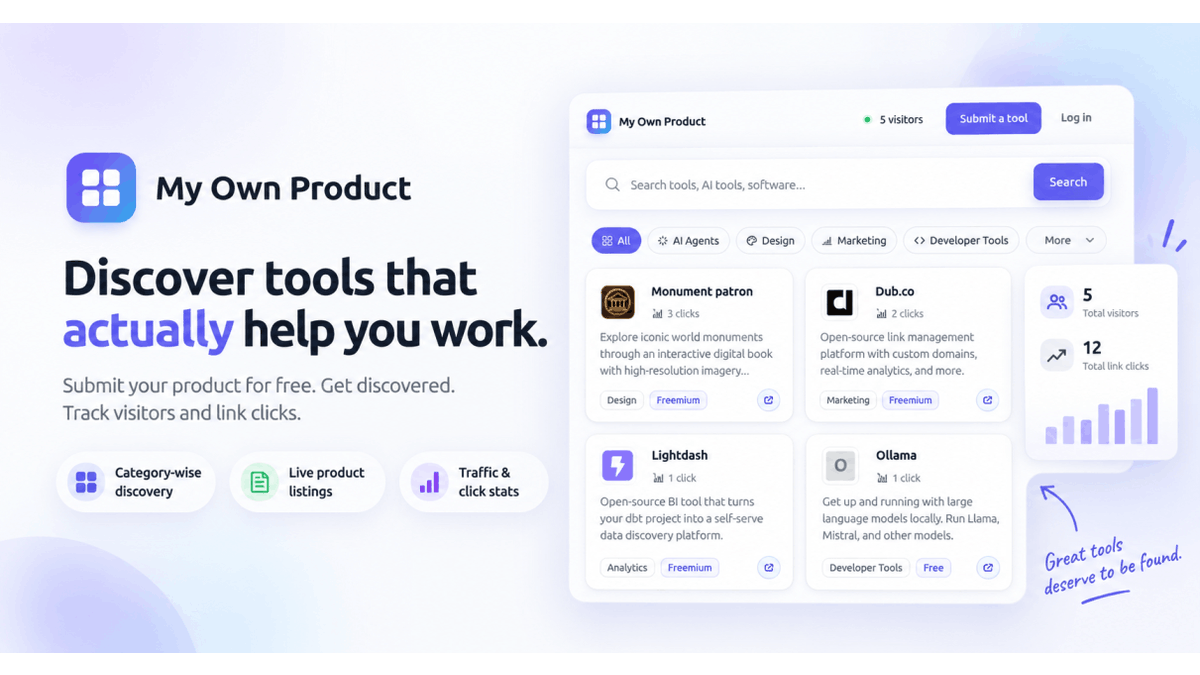
MyOwnProduct is a curated product discovery platform connecting people who build useful software with people looking for solutions.
Makers can submit their products for free, without being required to place a backlink on their own website.
Visitors can explore tools through product listings and categories, understand what they offer, and follow links to the makers' official websites.
The idea is straightforward.
Instead of expecting every founder to build an audience from zero, we want to make it easier for people to discover products based on what those products actually help them accomplish.
A good product deserves a clear explanation and a chance to be considered by the right audience.
A useful product listing is more than a logo and a website link.
It gives someone enough context to decide whether a tool is worth exploring.
On MyOwnProduct, we focus on making products understandable and discoverable through several important elements.
A product's name alone rarely explains its value.
Descriptions help visitors understand what the software does, the problems it addresses, and the kind of people who might benefit from it.
Clear information also helps establish the context search engines need to understand a page.
Not every potential customer knows the name of the tool they need.
Someone might simply be exploring marketing software, developer tools, AI applications, or productivity solutions.
Organizing products into relevant categories gives visitors a practical way to explore available options.
This creates another discovery path beyond searching for a specific brand.
A public product listing gives makers another place to explain their software and direct interested visitors toward their own websites.
It can also be shared when introducing the product to communities, potential customers, or other makers.
For search engines, an accessible and useful page may create another opportunity for discovery, although indexing and rankings are never guaranteed.
Getting 10,000 random impressions isn't necessarily better than attracting a handful of people who actually need your solution.
Someone exploring a software directory may already be comparing tools or looking for a way to complete a task.
That makes relevance especially important.
Our goal isn't simply to create more page views. It's to help useful products connect with interested people who may become visitors, users, or customers.
You don't need a huge advertising budget to start improving how people discover your software.
Start with a few practical steps:
A product directory can support your marketing, but it shouldn't replace your own website, content, community participation, or customer conversations.
Let's say your SaaS helps small businesses manage their inventory.
A thousand visitors looking for entertainment might bring impressive-looking analytics, but very little value.
Ten business owners actively researching inventory software could be much more relevant.
That distinction matters to us.
We don't want MyOwnProduct to be just another place where founders collect links.
We want it to be useful for both sides: makers trying to explain what they've built, and visitors trying to find software that solves a problem.
Discovery should begin with usefulness, not hype.
Building a product takes effort, patience, and countless decisions that most people never see.
It would be a shame if all that work depended on a single launch post getting enough attention.
Good SEO is a long-term process. Product discovery is another piece of the same journey. Neither promises instant success, but both can help create more ways for people to find what you've made.
A useful product shouldn't have to become viral before someone gets the chance to discover it.
That's the idea behind MyOwnProduct.
If you're building a SaaS, developer tool, AI application, or another useful digital product, we'd love to see what you're working on.
Explore the platform, discover independent products, or submit your own for consideration.
Visit MyOwnProduct — because building something useful is only the beginning. Helping the right people find it matters too.