Product Story
How I Built a Curated Product Discovery Platform That Actually Helps Makers Get Found
From a side project to a live catalog: how My Own Product helps software makers and indie founders get discovered by real buyers and builders.
Loading page
Product Story
From a side project to a live catalog: how My Own Product helps software makers and indie founders get discovered by real buyers and builders.
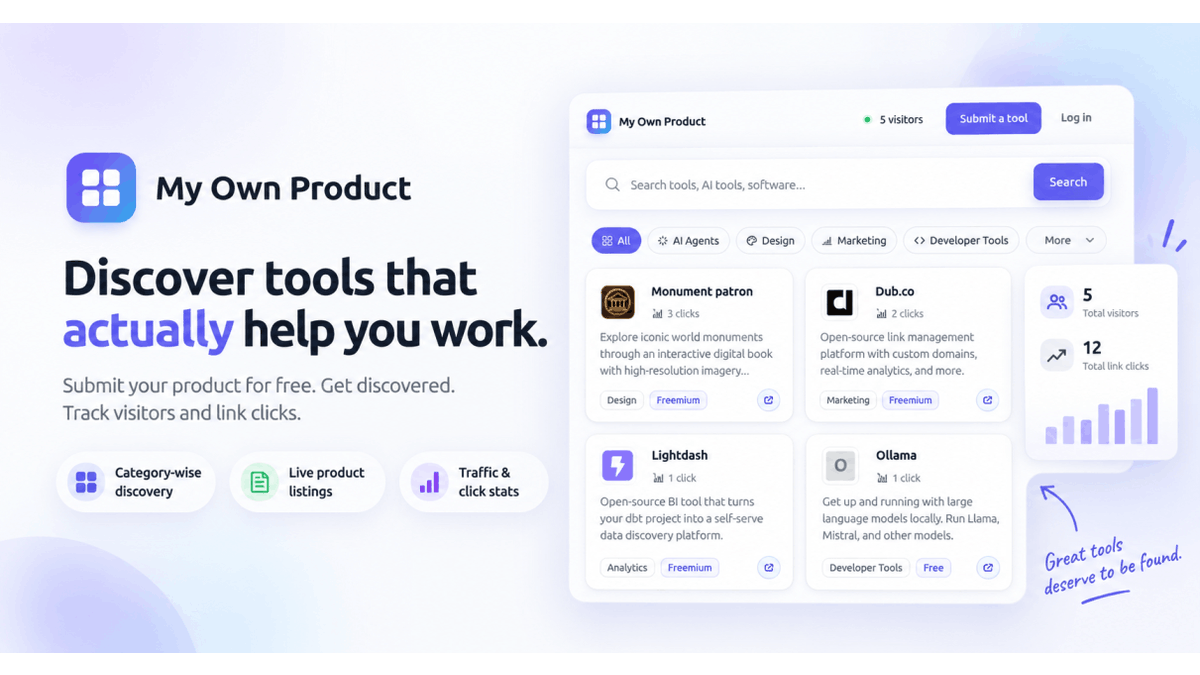
Every week I discovered incredible software tools through Twitter threads, Hacker News comments, or a random blog post. But finding the right tool at the right moment — when I actually needed it — was painful.
Existing directories were either outdated, ad-driven, or so overwhelmed with submissions that quality control was non-existent. Thousands of listings, no editorial care, no way to trust what you were reading.
What if there was a catalog where every listed product was genuinely reviewed, described honestly, and organised in a way that respects the buyer's time?
That question became My Own Product.
The first challenge was structure. A product catalog sounds simple until you start modelling the real world:
I built the data model carefully from day one. A canonical URL hash deduplicates products automatically. Category taxonomy is flat but filterable. Every listing has both a short card description and a long detailed view, because discovery and evaluation are two different moments in a buyer's journey.
Letting anyone submit a product is easy. Maintaining quality is hard.
My Own Product has a structured submission flow where founders describe their tool, pricing model, and company. Each submission enters a review queue. Approved listings go live with a unique public product page, SEO-optimised metadata, structured JSON-LD, and a canonical URL that search engines can index with confidence.
The admin review interface was built to be fast: approve, request changes, or reject in seconds. No bloated CMS, no complex workflow states.
The catalog answers what a product does. But buyers increasingly want to understand who built it and why.
That led to the Stories feature — a space where product makers can share their build journey in long-form writing. Think of it as a blog that lives directly next to the product it talks about. Founders can write about technical architecture decisions, early growth lessons, or the customer insight that led to their biggest product pivot.
Stories are full Markdown, rendered with proper heading hierarchy, code blocks, and image support. Each story is independently indexed, linked back to the product, and surfaced in related reading recommendations.
What worked well: - Building on Laravel and Livewire kept the codebase lean and the developer experience smooth. - The company-fair ordering algorithm ensures that in the mixed feed, every brand gets equal first-impression visibility before any brand appears twice. - Custom pagination, SEO metadata, geo headers, and robots.txt were built as first-class features — not afterthoughts.
What was genuinely hard: - Deduplication logic for product domains across shared hosting providers. - Making the submission form honest without making it intimidating for first-time founders. - Designing a story editor that felt as natural as writing in Notion but produced clean, semantic HTML.
My Own Product is live and actively being refined. The roadmap includes:
If you have built something worth discovering, submit your product. And if you have a story to tell about how you built it — write it here.